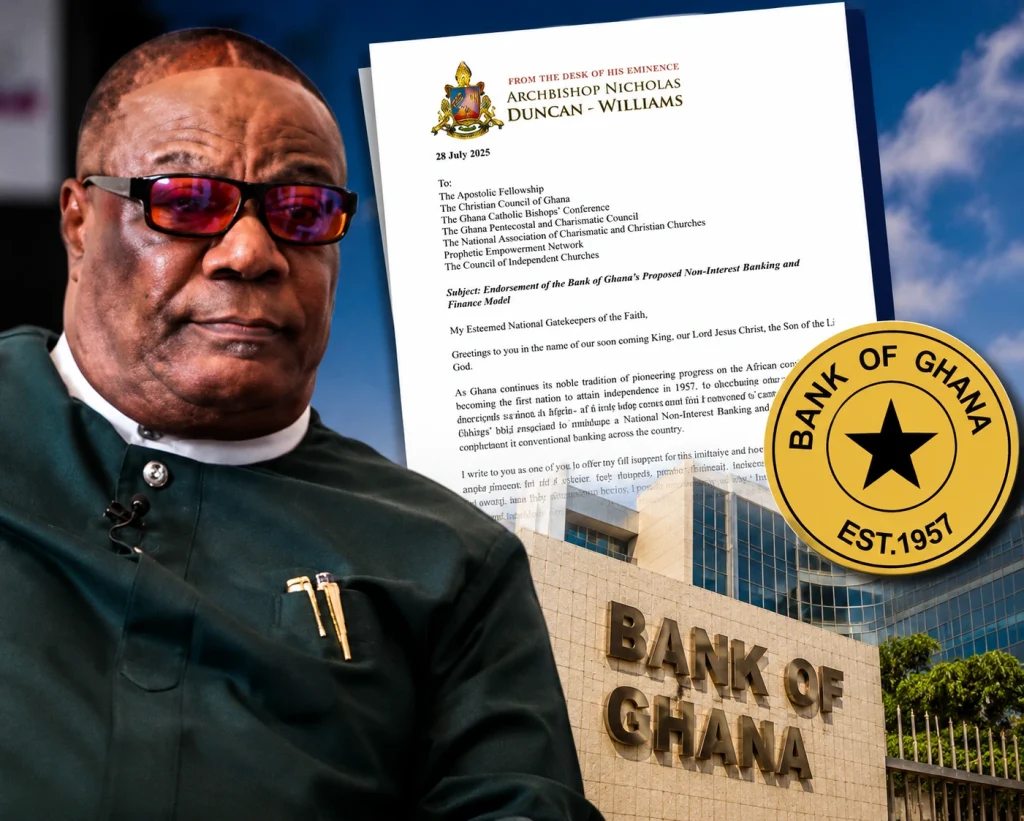
A document circulating online and dated July 28, 2025, purports to show Archbishop Nicholas Duncan-Williams expressing support for the Bank of Ghana’s proposed Non-Interest Banking and Finance model.
The letter, addressed to major Christian bodies including the Christian Council of Ghana, the Ghana Catholic Bishops’ Conference, the Ghana Pentecostal and Charismatic Council and the National Association of Charismatic and Christian Churches, is titled “Endorsement of the Bank of Ghana’s Proposed Non-Interest Banking and Finance Model.”
According to the document, Duncan-Williams urged church leaders to support the initiative, describing it as an opportunity to develop a Ghanaian financial model grounded in what he characterised as faith, ethical values, transparency and inclusion.
However, GhanaMedia.net has not independently verified the authenticity of the circulating letter or confirmed that it was officially issued by the Archbishop’s office. The claims in the document should therefore be treated as allegations until the original document or an authoritative confirmation is available.
Ghana already moving toward non-interest banking
The broader policy initiative referenced in the document is genuine.
The Bank of Ghana has been developing a regulatory framework for Non-Interest Banking and Finance (NIBF), with the central bank moving toward allowing conventional banks to establish non-interest banking windows as well as licensing fully fledged institutions dedicated to the model.
The framework follows Ghana’s existing legal provisions under the Banks and Specialised Deposit-Taking Institutions Act, 2016 (Act 930). In December 2025, the Bank of Ghana published an exposure draft of guidelines for the regulation and supervision of non-interest banking and finance.

The proposed system is intended to broaden financial inclusion and provide alternative financial products based on asset-backed and other non-interest structures.
Why the proposal matters
Non-interest banking is commonly associated with Islamic finance principles, including restrictions on interest-based transactions and greater emphasis on transactions linked to real economic activity.
However, Ghana’s regulatory approach deliberately uses the broader term “Non-Interest Banking” rather than simply “Islamic banking.” The stated objective is to create a framework that is accessible across Ghana’s religious and financial landscape rather than presenting the system as belonging exclusively to one faith.
The Bank of Ghana has also indicated that institutions operating under the framework will require appropriate governance, risk management, compliance and internal expertise before offering such products.
Duncan-Williams’ reported position
The circulating document attributes several arguments to Archbishop Duncan-Williams, including the view that Ghana should develop financial systems that reflect the country’s own values rather than simply copying foreign models.
The letter also appears to argue that a non-interest financial system could contribute to financial inclusion while promoting ethical approaches to wealth creation and investment.
If authentic, the intervention would represent a notable contribution to Ghana’s ongoing debate about how non-interest finance should be implemented.
Duncan-Williams has historically been an influential voice on national economic, political and social issues. Academic research has documented his longstanding engagement with national governance and economic questions, including previous public interventions concerning Ghana’s economy and financial conditions.
Questions surrounding the proposed model
The introduction of non-interest banking has also generated debate among financial experts.
Policy analyst Bright Simons has raised concerns about whether Ghana’s legal and judicial systems have sufficient expertise to handle disputes involving financial contracts based on Islamic finance principles. He has also questioned aspects of the proposed governance and regulatory arrangements.
Other stakeholders have stressed the importance of strong reporting, transparency, governance and consumer protection as Ghana prepares to operationalise the framework.
These issues will be important if non-interest banking is to gain public confidence and become a meaningful part of Ghana’s financial system.
A developing financial debate
Ghana’s move toward non-interest banking comes as policymakers seek to diversify financial products, deepen inclusion and attract new forms of investment.
The proposed framework could eventually give businesses and individuals additional financing and investment options, but its success will depend on effective regulation, public education, professional capacity and confidence in the institutions implementing it.
For now, the reported Duncan-Williams endorsement adds another layer to an already significant national conversation—but the authenticity of the specific letter circulating online remains to be independently established.