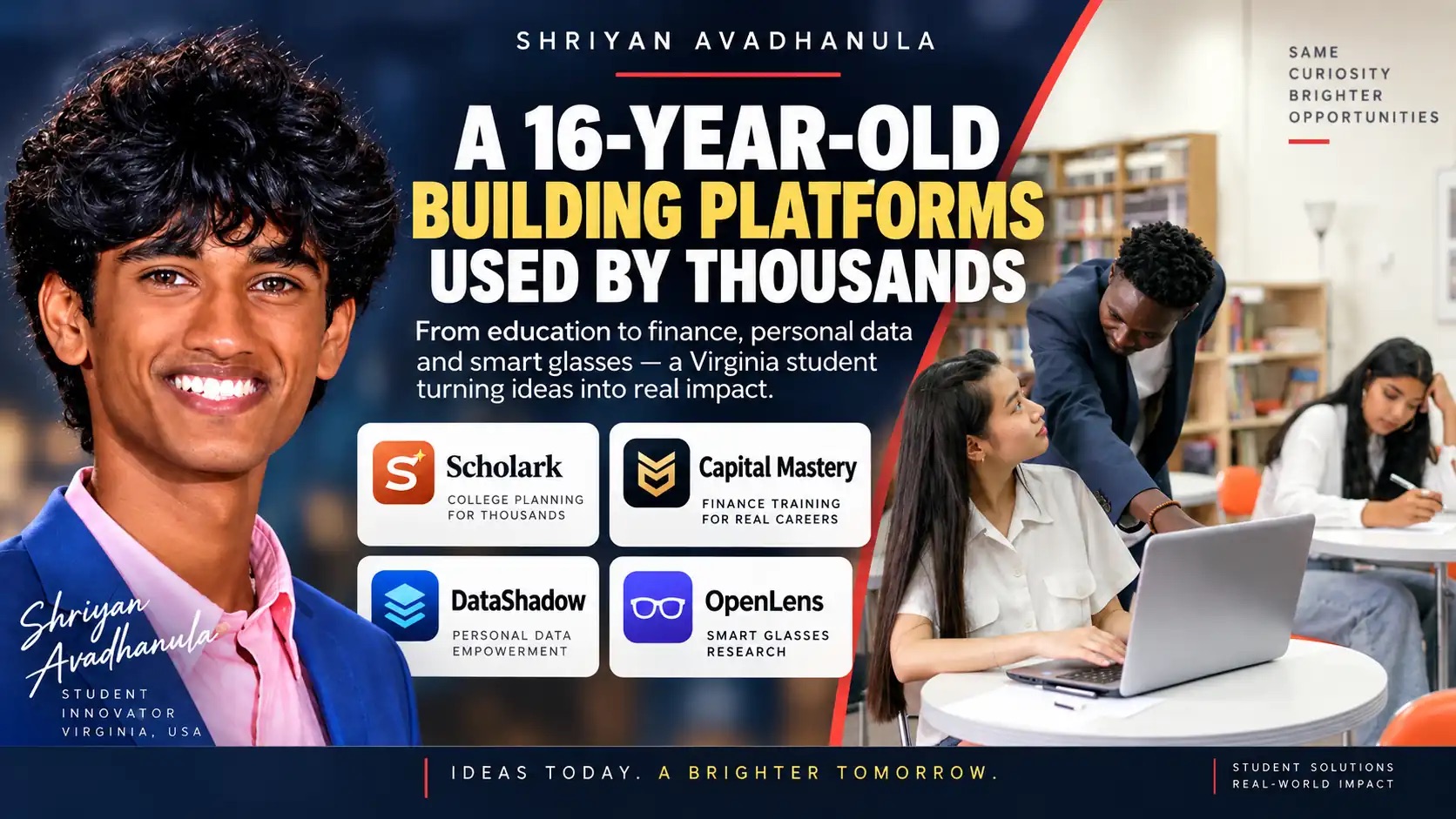
From a free college toolkit with more than 10,000 monthly users to finance training, personal-data technology and smart-glasses research, the Virginia student is building a portfolio that reaches well beyond the classroom.
By Shriyan Avadhanula and Daniel Jeddman
At 16, Shriyan Avadhanula is already confronting a question that many entrepreneurs spend years learning how to answer: What do you build when you encounter something that does not work the way it should?
For Avadhanula, the answer has repeatedly been software.
A problem with tracking his grades became Scholark, a free college-planning platform that currently reports more than 10,000 students each month.
Questions about the difference between learning finance and actually performing finance work became Capital Mastery, a training platform designed around practical exercises, simulations and career preparation.
Questions about the economic and personal value of people’s digital information became DataShadow, a functional prototype for which Avadhanula says he filed a U.S. provisional patent application on August 19, 2026.
And his interest in emerging wearable technology led to OpenLens, a project designed to help people research, benchmark and simulate different smart-glasses capabilities.
The projects are different. The underlying habit is not.
Find a gap. Learn what is missing. Build something. Test it. Find another weakness. Learn again.
Scholark: A Student’s Problem Becomes a 10,000-User Platform
Scholark did not begin as a business plan. It began with a student trying to solve his own problem.
Avadhanula wanted a more useful way to calculate and track his academic performance. After building the initial GPA functionality, he began adding tools around the broader college-preparation process.
The result became Scholark.
Today, the official Scholark website describes the platform as a student-built, non-commercial educational project offering free academic and college-planning tools. Its public website currently reports 10,000+ students monthly, alongside tools covering GPA calculations, college comparisons, admissions guidance, SAT/ACT preparation, AP study resources, scholarships, student-loan calculations and essay feedback.
The platform also tracks more than 200 universities and provides tools designed to help students make sense of academic and admissions information.
But Avadhanula is careful about the limits of the technology.
An admissions calculator is an estimate. A college comparison is not a guarantee. An essay coach is not a replacement for an experienced counselor.
That distinction is important because the platform’s purpose is not to promise students an outcome. It is to make preparation easier.
Why Keep It Free?
The idea of giving students useful tools for free creates an obvious business question: How do you sustain the platform?
There are servers to maintain. There is development work. There is infrastructure. And there is the opportunity cost of spending hundreds of hours building something that does not currently operate as a conventional commercial company.
Scholark’s public website describes it as non-commercial, not incorporated as a company or employer, and not revenue-generating.
For Avadhanula, that has allowed the platform to focus on accessibility first.
But he is not necessarily arguing that free technology must always remain free.
The larger question is how a useful product can eventually sustain itself without destroying the accessibility that made people use it in the first place.
For now, the evidence of demand is already visible in the platform’s reported monthly usage.
From College Preparation to Investment Banking
The next platform grew from a different realization.
Knowing finance terminology is not the same thing as knowing how to perform financial work.
A student might understand what enterprise value means. That does not automatically mean the student can construct a valuation.
Someone may know the definition of comparable-company analysis. That does not mean they know which companies should be selected or how to defend the selection.
And someone can complete a finance course without ever experiencing the pressure of making a judgment when the answer is not obvious.
That gap became the foundation for Capital Mastery.
The platform is designed around practical finance career preparation, with training across areas including investment banking, private equity, corporate development, quantitative finance, FP&A, risk management, wealth management and real estate.
Its model combines learning with applied exercises, simulations, calculations, research, modelling and decision-making.
The platform’s public materials describe it as a free finance workforce-readiness system serving both individual learners and employers.
That distinction is important. Capital Mastery is not simply trying to teach students what finance professionals know. It is attempting to let learners practice what finance professionals do.
When the Classroom Meets the Workplace
According to materials supplied for this profile, Sterling Point Advisors, a boutique M&A advisory firm, agreed to use Capital Mastery as an in-house training resource for interns. Avadhanula says other firms in the United States have also used or considered the platform.
Those company-specific relationships are based on the supplied documentation and founder account rather than independently published corporate announcements, and are therefore presented here as attributed information.
For Avadhanula, however, the experience changed the standard by which he judged the platform.
A website can look impressive. A training system can contain hundreds of lessons.
But when professionals actually use it, the question becomes much simpler: Does it work?
That is also where mentorship has become important.
Avadhanula says his M&A work is reviewed by an experienced professional who challenges his assumptions and asks questions that cannot always be answered by simply remembering a formula.
Why these comparable companies? Why this assumption? What changes if the assumption is wrong? What happens to the valuation if the underlying premise changes?
The uncomfortable answer is often the most valuable one.
A weakness discovered through actual feedback is difficult to forget.
More Than 80 Credentials — But Credentials Are Not the Point
Avadhanula’s own learning record has grown alongside his platforms.
The material supplied for this profile says he has accumulated more than 30 professional-learning credentials, certifications and job simulations across finance, cybersecurity, artificial intelligence, risk management and technology.
His recent public LinkedIn post also describes reaching 30+ industry credentials, certifications and professional-learning programmes, naming organisations including Goldman Sachs, JPMorganChase, Anthropic, OpenAI, Microsoft, Bank of America, Citi, Mastercard, CFI and IBM.
That is a long list for anyone. At 16, it attracts even more attention.
But Avadhanula’s stated philosophy is that the certificates are only useful if they produce a capability.
A credential should lead to something he can build. A course should give him another framework. A simulation should make him better at doing the real task.
DataShadow: What If People Had More Control Over Their Data?
Then came DataShadow.
The concept begins with an increasingly familiar reality: people generate enormous quantities of data without necessarily understanding the economic and analytical value attached to it.
Searches. Purchases. Locations. Preferences. Habits. Digital activity.
Companies can use information like this to understand customers, forecast behaviour and make commercial decisions. But the individual generating the information often has little visibility into the process.
DataShadow asks a different question: What would personal data management look like if the individual had an intelligent system representing their interests?
The project’s public documentation describes DataShadow as a personal-data operating system and functional public-beta prototype. It allows users to import supported data, examine derived assets, define consent rules, test exchanges and maintain an auditable local record.
But one of the project’s most important features is not what it claims to do. It is what it explicitly says it does not claim to do.
DataShadow labels information according to whether it is real, public, modelled or simulated.
Its public documentation says buyer activity and monetary outcomes remain synthetic prototype scenarios during the public beta.
That matters. Technology demonstrations can easily blur the line between a prototype and a functioning commercial ecosystem.
A U.S. Provisional Patent Filed at 16
On August 19, 2026, DataShadow’s public documentation says Avadhanula filed a U.S. provisional patent application covering the platform’s integrated personal-data asset-management architecture.
It identifies Avadhanula as the sole inventor and records his age at filing as 16.
Avadhanula separately announced the filing publicly on LinkedIn, explaining that the project grew from a question about whether people could have greater control over how their personal information is accessed, protected and potentially valued.
A provisional patent application is not an issued patent. It does not mean the U.S. Patent and Trademark Office has granted a patent. It does, however, represent a formal intellectual-property filing connected to a technology project developed by a high-school student.
And DataShadow itself remains a prototype. Its public documentation says real-money settlement and verified production buyers belong to a potential future production phase rather than the current public beta.
OpenLens: Looking Beyond the Screen
Avadhanula’s newest major direction moves into hardware.
Smart glasses are developing quickly, but the category remains fragmented.
Different devices have different cameras, sensors, displays, developer environments and power constraints. Some have screens. Some rely almost entirely on audio and cameras.
That creates a problem for developers trying to build experiences that work across multiple devices.
OpenLens is intended to provide a research and experimentation environment around those differences.
Its public project documentation describes research, device comparison, simulation and benchmarking, while distinguishing manufacturer specifications from simulated behaviour and capabilities that have actually been tested.
OpenLens project documentation
From a Virginia Laptop to Shenzhen
According to correspondence supplied for this profile, Avadhanula was invited by Edison Li of RX Global to attend the 2026 Shenzhen International AI+AR Smart Glasses Industry Expo in China.
The invitation itself is based on supplied documentation.
The event, however, can be independently verified through its official organizer.
The Shenzhen exhibition is scheduled for October 27–29, 2026, at the Shenzhen World Exhibition & Convention Center. The organizer lists more than 3,600 exhibitors and brands and more than 170,000 visitors across concurrent exhibitions.
For a teenager who began exploring the smart-glasses ecosystem from a laptop in Virginia, the opportunity represents something software alone cannot provide: direct exposure to manufacturers, hardware engineers, optics, components, industrial supply chains and developers.
Avadhanula’s point is simple: “I can build a simulator on my laptop. I can’t simulate the whole industry.”
ATHENA, DinkSense and the Work Between the Headlines
The four major platforms do not represent the entire portfolio.
Avadhanula has also co-founded ATHENA, an athlete-intelligence research platform.
According to the figures published on his Scholark profile, ATHENA’s models have been validated across 27,548 athletes and 155,109 real-world race records.
He has also developed DinkSense, a privacy-focused coaching and performance-analytics project connected to pickleball.
And his work extends into cybersecurity through an annual Cyber Risk Intelligence Report.
This creates an unusual combination: education, finance, artificial intelligence, cybersecurity, personal-data technology, sports analytics and wearable technology.
The common thread is not a single industry. It is problem-solving through technology.
Why the Numbers Matter — and Why They Don’t
There are enough numbers in Avadhanula’s story to build an entire résumé around them.
10,000+ monthly Scholark users. 30+ professional credentials. 80+ Capital Mastery credentials. 27,548 athletes. 155,109 race records. A provisional patent. A smart-glasses industry invitation.
But numbers alone do not determine whether a technology project will survive.
Usage can fall. A prototype can fail. A patent application can never become an issued patent. A platform can outgrow its infrastructure. A business model can change. An idea can prove less useful in practice than it looked on paper.
Avadhanula appears to understand that.
That is why his comments repeatedly return to the same idea: Build first. Find the weakness. Learn. Improve.
At Some Point, Being 16 Stops Being the Story
Age makes the story remarkable today. But age will not remain the central fact forever.
Avadhanula will turn 17. Then 18. Then 20. Eventually, nobody will describe him as a teenage developer.
At that point, the platforms will have to stand on their own.
Scholark will have to continue delivering value to students. Capital Mastery will have to demonstrate that its practical training is useful to learners and organizations. DataShadow will have to withstand scrutiny from privacy specialists, cybersecurity professionals, lawyers and data-market experts. OpenLens will have to prove that developers and researchers can use it.
The technology will have to become more important than the biography.
And Avadhanula himself appears conscious of that.
“Being 16 might get someone to look once. It can’t be the reason they come back.”
Building Before Being Fully Ready
There is a traditional sequence for professional development: Study. Credential. Experience. Then build.
Avadhanula’s approach reverses parts of that process.
He builds. The project exposes what he does not know. He studies the missing knowledge. He builds again. Then somebody else tests it.
The cycle repeats.
That can be uncomfortable. Building something forces theoretical gaps into the open. A person can sometimes get through an examination while only partially understanding a concept. A real product is less forgiving.
If the understanding is incomplete, eventually something breaks.
Avadhanula describes that as part of the advantage of building. The weakness becomes visible. And once it becomes visible, it can be addressed.
A Cross-Border Collaboration
The story also connects the United States and Ghana through Avadhanula’s collaboration with Daniel Jeddman, journalist, author and publisher behind GhanaNews.org & GhanaMedia.net.

That collaboration forms part of the development and publication of this profile.
For GhanaMedia, the significance extends beyond the technology itself.
Young innovators are increasingly building globally from places that may be thousands of miles away from the industries they hope to influence.
A student in Virginia can build a college platform used by students beyond the United States. A teenager can develop finance simulations inspired by professional workflows. A personal-data prototype can raise questions about the future relationship between individuals and companies. And a smart-glasses project can eventually lead to conversations with an international hardware industry.
The geography of innovation is changing.
The internet makes the first connection possible. The quality of the work determines whether the connection lasts.
The Work Is Still Unfinished
There is no guarantee that every one of Avadhanula’s projects will become a major company.
There is no guarantee that DataShadow’s provisional filing will result in an issued patent.
There is no guarantee that a free educational platform will remain free indefinitely.
There is no guarantee that OpenLens will become an important developer tool.
Those uncertainties are not weaknesses in the story. They are part of what makes the story honest.
At 16, Avadhanula is not presenting himself as someone who has already solved these industries. He is building experiments around questions he believes are worth answering.
And the experiments are beginning to attract users, professional feedback and industry attention.
That is different from having finished. It is evidence of movement.
“I Want More Time to Get Better”
There is one idea that ties the entire portfolio together.
Avadhanula does not appear to regard being young as the destination. He regards it as additional time.
Additional time to learn finance. Additional time to understand cybersecurity. Additional time to experiment with artificial intelligence. Additional time to make mistakes. Additional time to rebuild. Additional time to discover whether the ideas actually work.
“I don’t want starting young to be the accomplishment. I want it to mean I had more time to get better.”
That is ultimately where the story of Shriyan Avadhanula stands.
Not at the finish line. Not at the point where a 16-year-old has supposedly figured everything out.
But at a much earlier and potentially more consequential stage: the point where curiosity has already turned into products that other people are beginning to use.
And somewhere today, a student may open Scholark without knowing the name of the person who built it.
They calculate their GPA. Compare a university. Practice for an exam. And then move on with their day.
For the creator, that may be the most meaningful form of validation.
The technology worked. The student got what they needed.
And the work continues.
Contact Shriyan: Gmail | LinkedIn
Follow GhanaMedia on X: @GhanaMedia123
Ghana News | Ghana News Live | Top Stories | Policy & Law Hub