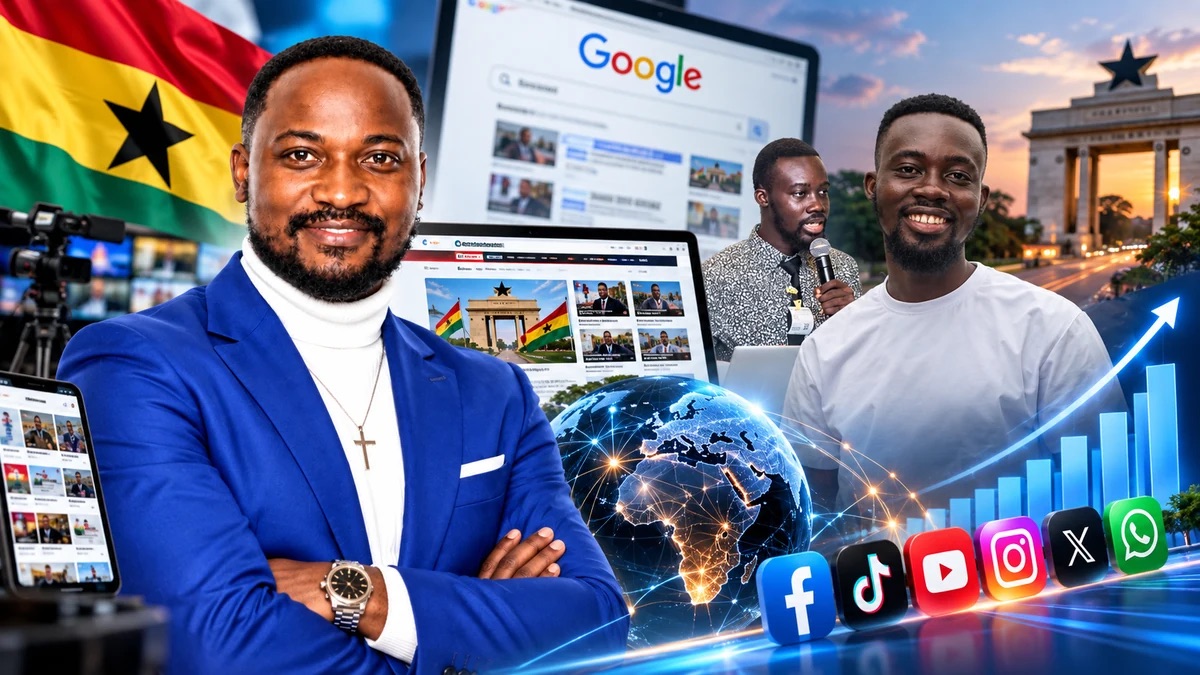
ACCRA, GHANA — GhanaMedia.net is entering a new phase in its digital publishing journey, with recent Google search visibility highlighting the growing footprint of the Ghanaian-owned news platform across search, social media, technology, journalism and international digital audiences.
Recent search results summaries reviewed by GhanaMedia.net have placed the platform within a broader digital-media context alongside major global social and publishing platforms. With a formal Google award certification, GhanaMedia.net is being highly represented within the modern search ecosystem of Google and all other search engines.
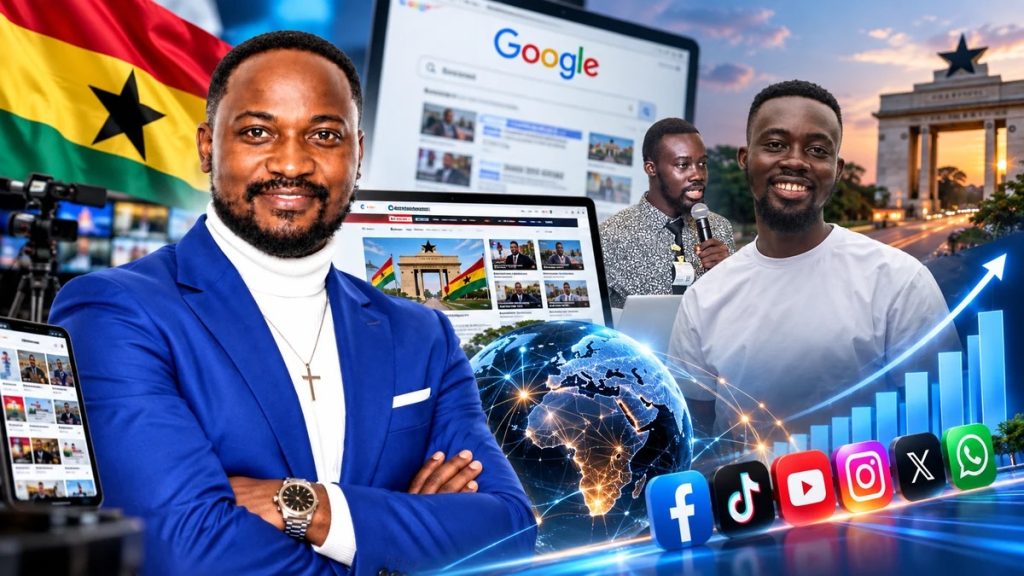
The significance of that visibility becomes clearer when viewed against the platform’s wider history: its development as a digital-first Ghanaian publisher, its search presence around terms such as Ghana News and Ghana Media, its rapidly expanding social audience, its technical performance, its growing international footprint, and its stated recognition within the Project Oasis ecosystem.
From a Ghanaian Digital Publication to a Broader Media Entity
GhanaMedia.net’s development reflects the larger transformation of African journalism from traditional distribution models toward mobile-first, search-driven and socially distributed publishing. The platform has built its identity around Ghana news, breaking developments, politics, business, entertainment, sports, technology and stories connecting Ghana with the wider African and international community.
Its current publishing architecture allows a single story to move simultaneously through the website, Google search, Google News-related discovery surfaces, social platforms and direct audience channels. That model has become increasingly important in an environment where readers no longer discover news through only one newspaper, television station or radio broadcaster.
GhanaMedia.net’s own published media materials describe the organisation as an independent digital newsroom focused on public-interest journalism, original reporting and Ghanaian and African audiences. Its Press & Media Room also documents the organisation’s public-facing position, editorial responsibility and Project Oasis-related recognition.
Project Oasis and the Larger Independent-Digital-Media Ecosystem
One of the most important parts of GhanaMedia.net’s evolving institutional profile is its connection to the Project Oasis ecosystem. GhanaMedia.net has published material describing its inclusion and recognition within Project Oasis, an initiative associated with the study and mapping of independent digital news organisations.
Google News Initiative materials independently confirm that Project Oasis is used as research concerning locally focused digital news organisations and has been incorporated into Google’s wider resources for understanding digital publishing and sustainable news businesses. This distinction matters because Project Oasis should be understood as a research and ecosystem initiative rather than automatically treating every listed publisher as a Google partner, employee, grantee or formally certified Google News organisation.
For GhanaMedia.net, however, participation or recognition within such an ecosystem remains significant because it places the organisation within a broader conversation about independent digital journalism, audience development, sustainability and the future of local news.
GhanaMedia.net has documented this development through its Project Oasis recognition and credibility profile and its broader article on independent digital media in Africa.
Daniel Jeddman and the Publisher Behind the Platform
At the centre of GhanaMedia.net’s development is its founder and publisher, Daniel Jeddman. Public professional information identifies Jeddman as the founder and publisher of GhanaMedia.net, while GhanaMedia.net’s own impressum identifies him as the publisher and person responsible for editorial content.

Jeddman’s professional profile combines journalism, publishing, digital media, creative production and entrepreneurship. His work has extended beyond simply operating a website: GhanaMedia.net has developed into a broader publishing identity with a presence across search engines, social networks and digital communities.
The publisher’s background also illustrates the increasingly interconnected nature of modern African media. Jeddman has worked across journalism and digital content while developing GhanaMedia.net as a platform capable of publishing rapidly across multiple subject areas and reaching audiences in Ghana, Africa and the diaspora.
GhanaMedia.net’s own biography and editorial pages describe Jeddman as a journalist, publisher and founder, while his professional LinkedIn profile identifies him as the founder and publisher of GhanaMedia.net. The organisation’s Impressum and editorial responsibility page further identifies him as the responsible publisher.
The Technical Foundation: Speed, Mobile Publishing and Search Visibility
Digital authority is not created by social followers alone. A modern news organisation also needs infrastructure capable of delivering large volumes of content quickly to readers using mobile devices and different network conditions.
GhanaMedia.net has repeatedly documented its technical performance. A 2026 GTmetrix benchmark published by the organisation reported an A grade, a 99 percent performance score, a 99 percent structure score, approximately 718 milliseconds Largest Contentful Paint, 6 milliseconds Total Blocking Time and zero Cumulative Layout Shift. Those figures represent a specific performance test rather than a permanent guarantee of performance, but they provide a measurable record of the technical optimisation work undertaken by the platform.
The significance of speed is particularly relevant for African digital publishing. A lightweight website can reduce friction for readers accessing breaking news through mobile connections, while efficient architecture can also improve the experience of crawlers and users moving through large quantities of rapidly published content.
GhanaMedia.net has previously documented this technical development in its articles GhanaMedia.net Achieves Near-Perfect 99% Speed Score, The 718ms Revolution and The Need for Speed.
Search Visibility Is Becoming Part of the Brand
The screenshots reviewed for this report provide another dimension to GhanaMedia.net’s development: entity visibility.
When users search for phrases such as “Ghana Media” or “Ghana News”, GhanaMedia.net appears within a wider search environment containing major media organisations, social platforms, video publishers and other digital entities. This means the platform is increasingly participating in the information ecosystem rather than operating as an isolated website.
Search visibility is especially important for a digital newsroom because every article can become an entry point into the organisation. A reader may encounter GhanaMedia.net through a Google search, a social post, a video, a direct visit, a shared article or a search query for a particular Ghanaian personality, event, institution or breaking story.
The platform’s expanding library of articles also creates a growing body of searchable information. Its Ghana Media archive contains a large and continuously expanding collection of reporting and commentary covering Ghanaian affairs, business, entertainment, sports, technology and international developments.
From Website to Multi-Platform Media Network
The modern Ghanaian newsroom is no longer defined by its domain name alone. Audience relationships increasingly exist across Facebook, Instagram, TikTok, YouTube, search engines, messaging platforms and websites.
GhanaMedia.net’s recent audience milestones illustrate this shift. A September 2026 report published by the platform stated that its Facebook audience had surpassed 663,000 followers, while its professional dashboard recorded 5.4 million views during a seven-day period. Those numbers demonstrate the importance of social distribution to the organisation’s publishing model, although social-platform metrics naturally change over time and should always be treated as time-specific measurements.
The combination of website publishing and social distribution gives GhanaMedia.net a significant ability to move information rapidly between platforms. A breaking story can originate on the website, be distributed through Facebook, appear in search results and subsequently circulate through video and social networks.
This is fundamentally different from the traditional newspaper model in which the publication itself was the primary destination. Today, the publication becomes an interconnected digital identity.
GhanaMedia.net has documented this development through its report on 663,000-plus Facebook followers and 5.4 million seven-day views.
The TikTok, Facebook and Search Connection
The Google search screenshots supplied for this report are particularly interesting because they show GhanaMedia.net appearing within a broader digital environment alongside social profiles and video results. This illustrates how contemporary media brands are increasingly understood through a combination of website authority, social identity and audience signals.
Facebook provides GhanaMedia.net with a large direct-distribution audience. TikTok and short-form video create another discovery pathway. Instagram provides another identity layer, while Google search connects the organisation to people actively looking for Ghanaian news and information.
These platforms do not confer authority automatically. Instead, they form parts of a wider digital footprint that can reinforce discoverability when supported by consistent publishing, recognisable branding, structured content and an established archive.
The Importance of the Ghana News Search Ecosystem
GhanaMedia.net’s strategy has increasingly centred on building a comprehensive information architecture around Ghanaian news. This includes dedicated sections for Ghana News, Ghana News Live, Top Stories and specialist policy and law coverage.
Such architecture matters because search engines do not evaluate a publisher only through one article. A mature news website can develop topical depth through hundreds or thousands of related pages, authorship signals, internal links, categories, archives and recurring coverage.
For a publisher such as GhanaMedia.net, the objective is therefore larger than achieving visibility for one headline. It is about building an identifiable digital entity associated with Ghanaian news and creating a structured archive capable of serving readers repeatedly.
International Recognition Requires More Than a Search Screenshot
The latest Google search visibility is encouraging, but the most credible way to present GhanaMedia.net internationally is to combine the screenshot evidence with independently understandable facts.
Those facts include the platform’s documented editorial identity, publisher information, technical benchmarks, social audience growth, public-facing media documentation and participation in the broader independent digital-news ecosystem.
This distinction is particularly important as Ghanaian publishers increasingly seek international partnerships. A strong media profile should never depend on a single AI-generated search answer. Instead, it should be supported by a network of verifiable signals that journalists, advertisers, researchers, institutions and potential syndication partners can independently examine.
Enoch Ansong: A Digital-Technology Partner in Ghana’s Emerging Creator Economy
The wider story also connects naturally to Enoch Ansong, popularly known as AI With Enoch, whose work represents another side of Ghana’s rapidly developing digital economy.
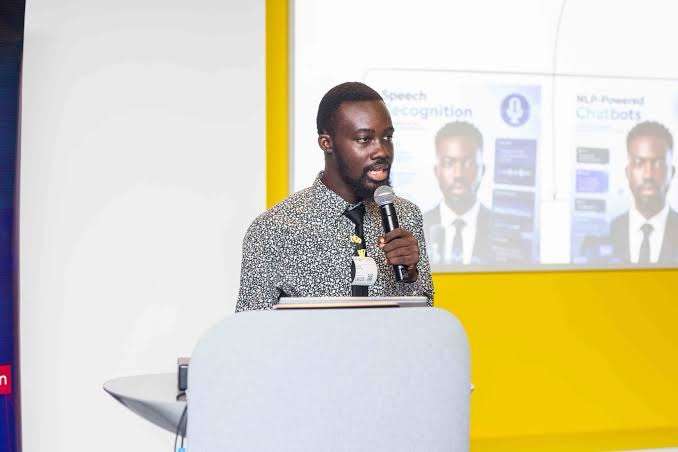
According to his current public profile, Ansong is an AI transformation partner, consultant, workflow developer, educator, trainer and software developer. He is the founder of Riverside AI and the AI With Enoch brand, with a focus on artificial intelligence education, automation and practical technology solutions for individuals, organisations and institutions.
His official website states that he has more than seven years of experience, has reached more than four million people through his work and has trained more than 10,000 people. His public biography also records work with institutions including the Parliament of Ghana Library Department and the Ministry of Finance Finance Division.
Ansong’s public professional profile further documents partnerships and work involving global technology companies and platforms. His current website identifies AI consultation, AI workflow and product development, AI training and workshops, and AI content and brand partnerships as core areas of his work.
His digital footprint therefore complements the story GhanaMedia.net is building: Ghanaian-owned digital brands increasingly operating at the intersection of media, technology, education, artificial intelligence, social platforms and international digital communities.
Further information about Ansong’s work can be found through AI With Enoch and his official biography.
24hrs of AI and the GhanaMedia Connection
The relationship between digital media and technology becomes even clearer through the 24hrs of AI project hosted by Enoch Ansong. The official event website lists Ghana Media among the partners and describes the project as a 24-hour live exploration of artificial intelligence, including AI education, live tool demonstrations, consulting and practical experimentation.
The collaboration illustrates how media organisations can participate in emerging technology ecosystems not merely as news publishers but as distribution, communication and community partners.
For GhanaMedia.net, such associations are strategically relevant because the future of digital journalism will increasingly involve artificial intelligence, automated workflows, multimedia storytelling, search technology, data analysis and personalised audience distribution.
Why the GhanaMedia.net Story Matters Beyond Ghana
GhanaMedia.net’s development should also be understood within the broader African digital-media transformation.
Africa’s media environment is becoming increasingly fragmented and increasingly connected at the same time. Readers can consume local news from a smartphone, watch an international broadcaster on YouTube, follow a Ghanaian journalist on LinkedIn, receive a breaking-news alert through social media and discover an independent publisher through Google Search — all within minutes.
This environment creates opportunities for independent publishers that can combine editorial consistency, speed, technical competence and audience understanding.
GhanaMedia.net’s history demonstrates an attempt to build precisely that kind of digital publishing infrastructure. Its strategy has combined rapid content production, mobile-first publishing, search optimisation, social distribution and an expanding archive of Ghana-focused journalism.
From Local Publisher to International Digital Identity
The strongest evidence of a media organisation’s development is not one ranking or one screenshot. It is the accumulation of signals over time.
For GhanaMedia.net, those signals now include a substantial publishing archive, an established founder and publisher, measurable social audience growth, documented technical performance, search visibility, an expanding international readership, public-facing editorial information and recognition within the broader independent digital-news ecosystem.
The Google search screenshots add another layer: they show that GhanaMedia.net is increasingly represented as an identifiable digital-media entity within searches for Ghanaian media and news.
That is important because the future of journalism is increasingly shaped by discoverability. A publisher that cannot be found cannot easily build an audience. A publisher that can be found but cannot retain trust cannot build lasting authority. The challenge is therefore to combine discoverability with editorial responsibility, technical reliability and consistent journalism.
A Foundation for the Next Chapter
The next stage for GhanaMedia.net is therefore larger than simply publishing more articles. It is about transforming accumulated digital visibility into a durable international media identity.
That means developing stronger newsroom documentation, building relationships with independent publishers, expanding syndication opportunities, strengthening author profiles, publishing transparent editorial policies, deepening international partnerships and continuing to invest in technical performance.
It also means allowing external audiences to evaluate the organisation through evidence rather than promotional language.
GhanaMedia.net’s Press & Media Room can serve as a central reference point for journalists, researchers, potential partners and organisations seeking information about the platform.
The Bigger Picture
The emergence of GhanaMedia.net reflects a much larger story about who gets to build influential media organisations in the digital age.
Digital publishing has lowered some of the traditional barriers to entry. A publisher with the right combination of editorial discipline, technology, audience strategy and persistence can build a media property that reaches audiences far beyond its original geographic market.
GhanaMedia.net is now operating within that environment.
Its current Google search visibility, social audience, technical performance and expanding publishing archive provide evidence of a digital organisation that has moved considerably beyond the concept of a small standalone website.
And with figures such as more than 663,000 Facebook followers and millions of social views being reported in September 2026, the organisation’s audience footprint is becoming an increasingly important component of its media identity.
At the same time, the platform’s documented Project Oasis-related recognition provides an additional institutional dimension to the story, while the work of technology educators such as Enoch Ansong demonstrates how Ghana’s digital ecosystem is producing new forms of media, technology and knowledge leadership.
Conclusion: GhanaMedia.net Is Building an Evidence-Based Digital Footprint
GhanaMedia.net’s latest visibility in Google search should therefore be viewed as one part of a much larger story.
It is a story about a Ghanaian digital publisher building a searchable archive; a social-media operation reaching hundreds of thousands of followers; a technically optimised news platform; a newsroom developing its public institutional identity; and a founder, Daniel Jeddman, continuing to develop the organisation across journalism, publishing and digital media.
The story also belongs to a wider generation of Ghanaian digital entrepreneurs, creators and technology educators — including Enoch Ansong of AI With Enoch — who are demonstrating that global digital influence can increasingly be built from Ghana.
For GhanaMedia.net, the objective now is not simply to appear in search. It is to become increasingly useful, recognisable, verifiable and valuable to audiences, journalists, researchers, institutions and partners across Ghana, Africa and the global diaspora.
The Google search evidence is therefore best understood not as a standalone certificate, but as another visible indicator within an expanding digital footprint — one that has been built through years of publishing, audience development, technical optimisation, social distribution and persistent investment in the future of Ghanaian digital journalism.
GhanaMedia.net is building its next chapter in public — one story, one reader, one search result and one digital connection at a time.