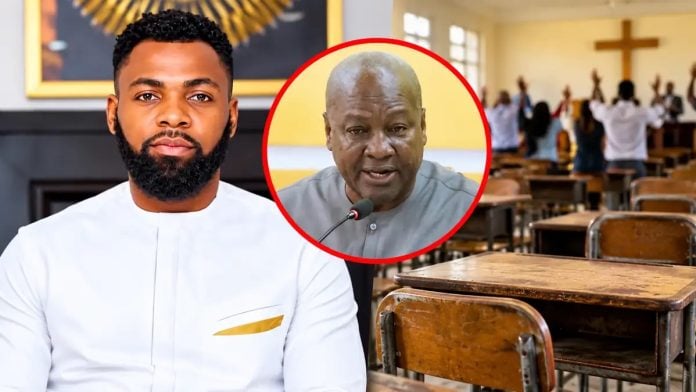
Samson Lardy Anyenini has issued a pointed warning directed at Ghana’s governing National Democratic Congress (NDC), saying, “You will reap what you are sowing.”
The journalist and legal practitioner shared the message alongside a biblical reference to Galatians 6:7, which states that whatever a person sows, they will also reap.
The remark has been framed as a warning about the consequences of actions and decisions taken by those currently in government.
Anyenini is the host of JoyNews’ Newsfile, where he regularly moderates discussions on governance, politics, public accountability and other national issues. Recent Newsfile discussions have included scrutiny of the government’s policies and performance, including education and other matters of public interest.
His latest message comes amid continuing public debate over the NDC administration’s record and the expectations surrounding its governance agenda.
The statement has generated attention because of its direct wording and its reference to the biblical principle of accountability.
ACCRA, Ghana — Minority Leader Alexander Afenyo-Markin has said his doctor has advised him to drop his court case against Sammy Gyamfi, citing concerns that the legal dispute is affecting his blood pressure.
Afenyo-Markin says doctor advised him to drop Sammy Gyamfi case.
Afenyo-Markin made the disclosure in a statement dated September 17, 2026, according to the statement shared in the accompanying report.
“My doctor has advised me to drop my court case against Sammy Gyamfi because it is affecting my BP,” Afenyo-Markin was quoted as saying.
The development comes amid an ongoing public dispute between Afenyo-Markin and Sammy Gyamfi, with the two Ghanaian politicians having exchanged criticisms over a number of political and public-interest issues.
Afenyo-Markin, who serves as the Minority Leader in Parliament, has been involved in several high-profile political and parliamentary debates in recent months. His decision regarding the court case would depend on the legal process and any formal action taken by his legal team.
Gyamfi, meanwhile, has continued to serve as a prominent figure in Ghana’s governing political administration, with his public comments and activities frequently drawing responses from opposition figures.
The latest statement places Afenyo-Markin’s reported health concerns at the centre of his decision to reconsider the legal action. However, the statement does not provide further medical details or specify the nature of the health advice he received.
The court case and the circumstances surrounding the dispute are expected to remain subjects of public interest as the two sides continue to navigate their political and legal differences.
For more Ghanaian political and parliamentary developments, follow GhanaMedia.net.
LOMÉ, Togo — Nel Amzo, born AGBEMADON Komi Olivier Abraham, is a Togolese filmmaker, director of photography, photographer and visual creator whose journey from experimenting with a smartphone has developed into professional work across film, music, photography, fashion and emerging visual technologies.
Born on July 12, 1997, in Baguida, Togo, Nel Amzo began developing his visual craft in 2015 while still in junior high school. Without specialised training or professional equipment, he started experimenting with photography using a Huawei phone and later a Samsung S3 under the pseudonym O2A.
From a smartphone to professional visual direction: Meet Nel Amzo.
What began with accessible technology gradually became a distinctive creative practice built around composition, lighting, staging and visual storytelling.
From Smartphone Photography to Professional Visual Direction
After obtaining his Baccalauréat A4 in 2018, Nel Amzo dedicated a year to artistic photography, developing an approach influenced by African culture and traditions while seeking to interpret them through a contemporary visual language.
His work eventually expanded beyond still photography into moving images. He began directing music videos in 2022, bringing together photography, staging, artistic direction, rhythm, lighting and storytelling.
For Nel Amzo, music-video production became an opportunity to build complete visual worlds around artists and their songs rather than simply document performances.
The evolution reflects a wider generation of African creators using accessible digital tools to develop professional careers in the creative industries.
Working Behind the Image at Belifornia Record
Nel Amzo’s progression led him to Belifornia Record, a structure associated with Togolese artist Santrinos Raphael, where he is described in the supplied press dossier as an official videographer and director of photography.
His responsibilities extend beyond operating a camera. According to the dossier, his work includes developing visual concepts before production, creating ideas, scripts and scenarios, directing the image and maintaining aesthetic consistency throughout productions.
This represents a shift from a primarily technical role towards broader visual conception and direction.
Readers can follow more stories about African creatives, entertainment and culture through Ghana News.
Exploring Artificial Intelligence and New Visual Technologies
Nel Amzo has also expanded his creative experimentation into new visual technologies, including tools connected to artificial intelligence.
His approach, according to the dossier, is not focused on replacing traditional creative processes but on exploring new methods of visual conception, previsualisation and storytelling.
The combination of conventional filmmaking techniques with emerging digital tools forms another part of his evolving creative identity as audiovisual technology continues to change.
Fashion, Photography and a Distinctive Identity
Beyond directing and photography, Nel Amzo has also worked in fashion and visual modelling. The dossier identifies collaborations including work as a photo model with the brand BEWAX Ekaa.
His recurring use of a mask and distinctive fashion choices have also become part of the visual identity associated with his public creative persona.
This creates an interesting connection between his professional work behind the camera and the image he constructs around himself as a visual artist.
His creative universe brings together African culture, contemporary fashion, photography, cinema, music and technology.
A New Generation of Togolese Visual Creators
Nel Amzo belongs to a generation of Togolese creatives developing audiovisual careers through music, digital platforms, artistic collaborations and technology.
His journey demonstrates how a practice that began with readily available equipment can gradually develop into professional responsibilities in filmmaking and visual direction.
His story also offers an example of the changing pathways into Africa’s creative industries, where formal equipment and traditional production structures are increasingly being complemented by accessible digital technologies.
For more African entertainment and creative-industry stories, follow Ghana News Live.
Building a Visual Language
At the centre of Nel Amzo’s development is an effort to create a personal visual language. His work brings together elements of African culture with contemporary aesthetics while allowing photography, music videos, fashion and new technologies to influence one another.
The supplied press dossier recommends the editorial angle of tracing his journey from a smartphone to professional image direction, while also exploring his role in shaping visual identities for artists and his experimentation with artificial intelligence.
For readers interested in the people shaping Africa’s contemporary creative landscape, his progression provides a story of experimentation, persistence and the gradual development of professional visual skills.
More African culture, entertainment and human-interest stories are available through GhanaMedia.net’s Top Stories.
As Nel Amzo continues to work across filmmaking, photography, music, fashion and emerging visual technologies, his journey remains an evolving example of how African creators are building their own visual identities and professional pathways.
Related developments in Ghana’s creative economy, technology and cultural industries can also be followed through the Policy & Law Hub.
HAMBURG, Germany — A Ghanaian-born teenager, Sylvester A., is making waves in Germany’s technology space after securing second place at a major AI Agents Hackathon in Hamburg at just 16 years old.
Sylvester participated in the first cargonerds AI Agents Hackathon, taking two days away from school to compete alongside his team. His performance earned the team a second-place finish and opened the door to a new professional opportunity.
Ghanaian-born teen joins German tech company after AI hackathon success.
Following the hackathon, Sylvester joined cargonerds as a Software Developer Trainee, officially becoming part of the company’s team on August 1.
The achievement marks an early milestone for the young programmer, who is building his technology career in Germany while bringing a Ghanaian background to an increasingly international software-development environment.
According to cargonerds, Sylvester competed together with Anton Barr and their team during the hackathon before being selected to join the company as a trainee.
From School to Software Development
Sylvester’s story highlights how young people can gain practical technology experience while still pursuing their education. At 16, his participation in an AI-focused hackathon gave him an opportunity to demonstrate his programming abilities in a competitive environment.
His transition from hackathon participant to software developer trainee also provides an example of how technology competitions can create pathways into the professional software industry for young developers.
The development adds to growing interest in Ghanaian talent making an impact internationally, particularly across technology, artificial intelligence and software development.
Readers can follow more technology and innovation stories through Ghana News on GhanaMedia.net.
A Young Ghanaian Talent in Germany’s Tech Scene
Based in Germany, Sylvester is now beginning his professional journey with cargonerds while continuing to develop his skills in software development and artificial intelligence.
His achievement comes at a time when AI and software engineering are rapidly creating new opportunities for young developers around the world.
For a teenager who was still in school when he entered the hackathon, securing second place and subsequently joining the company represents a significant step towards a career in technology.
His journey also demonstrates the value of giving young people opportunities to test their abilities beyond the classroom and work alongside experienced developers and technology professionals.
Follow Ghana News Live for more stories on African talent, technology and innovation.
More developments involving young African professionals and emerging technology can be found in GhanaMedia.net’s Top Stories.
As Sylvester begins his new role as a Software Developer Trainee, his progress could offer an inspiring example of how early exposure to programming, artificial intelligence and technology competitions can open doors to professional opportunities.
Related developments in Ghana’s technology, business and digital economy can also be followed through the Policy & Law Hub.
ACCRA — Hollard Life Assurance Ghana, a subsidiary of Hollard Ghana, has appointed Sosthenes K. Konutsey as its new Managing Director, bringing more than two decades of experience across insurance, banking, pensions and digital health to the leadership of the life insurance business.
Hollard Life appoints Sosthenes K. Konutsey as Managing Director.
In his new role, Sosthenes will provide strategic leadership for Hollard Life, with a focus on sustainable and profitable growth, customer value, innovation, operational excellence and strengthening the company’s relationships with customers, partners and other stakeholders.
Commenting on the appointment, Hollard Ghana Group CEO Patience Akyianu said the company was excited to welcome Sosthenes to the Hollard family, highlighting his extensive industry experience, people-centred leadership style and passion for innovation.
“His extensive industry experience, people-centred leadership style, and passion for innovation make him well-positioned to lead Hollard Life,” Akyianu said, adding that the appointment aligns with Hollard’s purpose of enabling more people to create and secure a better future.
She further expressed confidence that Sosthenes would bring his experience and energy to drive exceptional and inclusive growth across the business.
Sosthenes said he was honoured to join Hollard Life and looked forward to working with the company’s team, customers and partners to build on its existing platform.
“Hollard is a brand with a strong reputation for innovation, customer focus and challenging the status quo,” he said. “I am excited about the opportunity to work with the team to build an even stronger life insurance business, one that delivers exceptional value to customers, creates opportunities for our people and contributes meaningfully to the growth of insurance in Ghana.”
Before joining Hollard Life, Sosthenes served as Country Manager of BIMA Ghana, where he led a workforce of more than 700 employees and a distribution network of about 500 agents.
During his tenure at BIMA Ghana, he led initiatives aimed at expanding access to inclusive insurance and digital health solutions while strengthening the company’s presence in the Ghanaian market.
He has also held senior leadership positions at Ghana Life Insurance and Old Mutual, where he gained extensive experience in insurance distribution, business development and business growth.
The appointment comes as Ghana’s insurance sector continues to evolve, with insurers increasingly focusing on customer experience, financial inclusion, digital solutions and innovative products. Readers can follow the latest Ghana News and business developments on GhanaMedia.net.
Hollard Life’s Growing Focus on Customer-Centred Insurance
Hollard Life remains focused on delivering customer-centred insurance solutions while strengthening its position as a trusted and purpose-driven insurer in Ghana.
Hollard Life is the youngest subsidiary of Hollard Ghana and was established in 2018. The company offers a range of life insurance products, including funeral insurance, savings and investment products, group life insurance and employee plans.
Hollard Ghana combines local market knowledge with the international expertise of its parent group, which is headquartered in South Africa.
The company was previously known as Metropolitan Insurance, which operated in Ghana for more than 25 years before becoming part of the Hollard brand.
Beyond its nationwide office network, Hollard makes its insurance services available through selected Shell Fuel Station Welcome Shops, Melcom stores and online platforms.
As Sosthenes takes over leadership of Hollard Life, his experience across insurance, digital health, distribution and business development is expected to shape the company’s next phase of growth and customer engagement.
For more updates on Ghana’s corporate sector, financial services and major business appointments, follow Ghana News Live and GhanaMedia.net’s Top Stories.
Developments affecting Ghana’s business environment, regulation and financial sector can also be followed through the Policy & Law Hub.
ACCRA — Ghana has reduced fuel exports to neighbouring Burkina Faso and Mali as rising domestic demand puts increasing pressure on petroleum supplies.
State-owned fuel distributor BOST Energies has cut diesel and gasoline exports to the two countries since August, with the company prioritising Ghana’s local market amid tighter global fuel supplies.
BOST Managing Director Afetsi Awoonor said Burkina Faso requested 80,000 metric tonnes of fuel for July and August but received only 40,000 tonnes. During the same period, Mali received 10,000 tonnes despite requesting an additional 40,000 tonnes for August and September.
The decision comes as global energy markets face supply pressures linked to conflicts in Ukraine and the Middle East. Rising international costs have placed additional pressure on fuel markets across Africa.
Burkina Faso and Mali, both landlocked countries, rely heavily on petroleum imports routed through coastal West African states, including Ghana and Côte d’Ivoire. The reduction in Ghanaian supplies could therefore have wider implications for regional fuel distribution and cross-border trade.
In Ghana, BOST holds about 30 percent of the fuel import and distribution market, while diesel consumption continues to rise alongside expanding economic activity. According to Awoonor, increased demand has strained supplies and complicated efforts to maintain stable domestic fuel prices.
The development adds another important dimension to Ghana’s Ghana News landscape, particularly as energy security and regional trade become increasingly important issues for the country and its neighbours.
Pressure on Ghana’s Domestic Fuel Market
Ghana’s fuel market has also faced international price pressures in recent months. Although prices had eased earlier in the year following currency improvements and government interventions, renewed pressure on global energy supplies has created fresh uncertainty.
The decision by BOST to prioritise domestic requirements reflects the challenge of balancing Ghana’s own energy needs with its role as a supply route for neighbouring landlocked economies.
The situation is being closely watched across the region as businesses, transport operators and consumers remain sensitive to changes in petroleum prices and availability. Follow Ghana News Live for continuing developments.
Burkina Faso and Mali Face Regional Supply Pressure
The fuel reductions highlight the vulnerability of landlocked Sahel economies to disruptions in regional supply corridors. Their dependence on coastal countries means changes in export volumes can have consequences beyond the immediate markets where the fuel is sourced.
For Ghana, the immediate priority remains ensuring adequate supply for the domestic market while managing its position within the wider West African petroleum trade.
BOST is also planning new infrastructure to strengthen Ghana’s domestic LPG supply. The company has announced plans for an LPG terminal in Tema by the fourth quarter of 2027, alongside storage facilities in Kumasi and additional locations across the country.
Those investments form part of a broader effort to improve fuel storage and distribution capacity as Ghana’s energy needs continue to evolve.
For more major developments, follow GhanaMedia.net’s Top Stories, while the Policy & Law Hub provides coverage of key economic and regulatory issues affecting Ghana.
Ghana’s decision to prioritise domestic fuel supply is likely to remain significant for both its local energy market and its role in supplying neighbouring Sahel countries.
AHАFO ANO NORTH — A controversy has emerged involving an NDC constituency youth organizer who is also reported to serve as a Youth Employment Agency (YEA) Director for Ahafo Ano North.
According to claims circulating in connection with footage shared online, the organizer was allegedly confronted over an intimate encounter involving the wife of another NDC Ahafo Ano North Branch Organizer.
NDC constituency youth organizer faces controversy over alleged intimate encounter.
The incident has attracted attention online, with footage appearing to show the man in a room during the confrontation. The circumstances surrounding the recording, including when and where it was made, have not been independently established.
The allegations have also raised questions about the responsibilities of political party organizers and public officials, particularly where conduct outside official duties becomes a matter of public controversy.
While the identities and positions attributed to those involved have been circulated alongside the footage, claims about the incident should be treated cautiously until the individuals concerned provide their accounts or further independently verifiable evidence emerges.
For the latest developments from Ghana’s political landscape, readers can follow Ghana News and ongoing updates through Ghana News Live.
The controversy comes as political party structures continue to attract public attention, particularly around the conduct of constituency-level officials and organizers. GhanaMedia.net will continue to follow any verified developments or responses from the individuals involved.
Readers can also follow the latest political and national developments through Top Stories.
Questions concerning public appointments, institutional responsibilities and governance can be followed through the Policy & Law Hub.
MORE DETAILS AND RESPONSES FROM THE PARTIES INVOLVED ARE EXPECTED.
The High Court in Accra has remanded four Ghanaians over alleged involvement in the export of nearly four tonnes of cocaine from Ghana to France. Musah Attah, known as “Kromo,” is among those charged.
Editorial Label: CRIME | INVESTIGATION | GHANA | INTERNATIONAL
Verification Status: VERIFIED COURT REPORT — Four accused have been charged and remanded; the alleged role of Musah Attah as a close-protection officer at the Office of the President is not independently confirmed by the sources reviewed.
Musah Attah Named Among Four Accused
A Ghanaian identified as Musah Attah, alias “Kromo,” has been formally charged alongside three other people over an alleged attempt to export nearly four tonnes of cocaine from Ghana to France.
The four accused — Desmond Koranteng Curiel, alias “Paul Kweku Yeboah” or “Biggs”; Musah Attah, alias “Kromo”; Kweku Otchere; and Jessica Hartog — appeared before the High Court in Accra on September 16, 2026.
They were charged with conspiracy to commit a crime involving the exportation of narcotic drugs without a licence and the exportation of narcotic drugs.
The court remanded the accused and scheduled the case for a further hearing on October 13, 2026.
The accused have pleaded not guilty, according to court reporting.
The Cocaine Seizure in France
The Ghanaian case follows a major cocaine seizure by French customs authorities at the port of Dunkirk on September 10, 2026.
French authorities seized approximately 3.9 tonnes of cocaine concealed inside a container carrying plastic waste that had arrived from Ghana. The shipment has been reported as having an estimated street value of approximately €225 million.
Part of the consignment was reportedly intended for onward movement to Antwerp, Belgium.
The seizure prompted cooperation between Ghanaian and French authorities as investigators sought to establish how the suspected narcotics were allegedly moved from Ghana into the international supply chain.
What Prosecutors Alleged in Court
According to the prosecution’s brief facts reported in court, Ghana’s Narcotics Control Commission (NACOC) received information about a 40-foot container containing plastic waste that had originated from Ghana and was subsequently intercepted in France.
The prosecution alleged that the accused were connected to the shipment.
It further said NACOC arrested three of the accused on September 12, while Musah Attah was arrested on September 14 at NACOC headquarters, according to the court account.
The prosecution also said searches conducted during the investigation resulted in the retrieval of three guns, four luxury vehicles, passports, ammunition and various sums of money.
These are prosecution claims presented in the ongoing case and have not been established as evidence of guilt.
Who Is Musah Attah?
The court reporting identifies Musah Attah, 47, by the alias “Kromo” and describes him as a farmer.
The supplied graphic circulating online describes him as a close-protection officer at the Office of the President.
However, GhanaMedia has not found a reliable current official or independent source confirming that employment description in connection with the present case. It is therefore not being presented as an established fact.
The distinction is important because the criminal charges concern the alleged exportation of narcotic drugs and conspiracy. They do not, at this stage, establish that Musah Attah is guilty of the offences alleged against him.
The Other Accused
Desmond Koranteng Curiel, also known as Paul Kweku Yeboah or “Biggs,” is described in the prosecution’s account as a 34-year-old businessman/business broker.
Kweku Otchere, 32, is described as a businessman.
Jessica Hartog, 34, is described as a beautician and the fiancée of Curiel.
A fifth person, Jos Leijdekkers, a Dutch national also known as “Bolle Jos,” has been named in connection with the investigation and remains at large, according to court reports.
NACOC has previously alleged that people arrested in Ghana were connected to or facilitated the activities of Leijdekkers in Ghana.
The Accused Deny the Charges
The court proceedings have not established guilt.
The four accused have pleaded not guilty to the charges. The prosecution’s allegations remain subject to the judicial process, and the accused are presumed innocent unless proven guilty in accordance with Ghanaian law.
The case is expected to return to court on October 13, 2026.
Why the Case Matters
The investigation has attracted attention because of the scale of the French seizure and the international route involved.
Nearly four tonnes of cocaine were found concealed in a commercial container originating from Ghana, while the subsequent Ghanaian investigation has resulted in criminal charges against four people.
The case also involves cooperation between Ghanaian and French authorities as investigators attempt to establish the full chain behind the shipment.
For now, the central facts established through the court proceedings are that four people have been charged, they have pleaded not guilty, and they remain in custody pending further proceedings.
The wider allegations — including who organised the shipment, how the drugs entered the container, who financed or facilitated the operation and what roles individual accused persons allegedly played — remain matters for the ongoing investigation and court process.
GhanaMedia will continue to follow the case as proceedings develop.
From a free college toolkit with more than 10,000 monthly users to finance training, personal-data technology and smart-glasses research, the Virginia student is building a portfolio that reaches well beyond the classroom.
Virginia student Shriyan Avadhanula is building technology platforms across education, finance, personal data and smart glasses.
By Shriyan Avadhanula and Daniel Jeddman
At 16, Shriyan Avadhanula is already confronting a question that many entrepreneurs spend years learning how to answer: What do you build when you encounter something that does not work the way it should?
For Avadhanula, the answer has repeatedly been software.
A problem with tracking his grades became Scholark, a free college-planning platform that currently reports more than 10,000 students each month.
Questions about the difference between learning finance and actually performing finance work became Capital Mastery, a training platform designed around practical exercises, simulations and career preparation.
Questions about the economic and personal value of people’s digital information became DataShadow, a functional prototype for which Avadhanula says he filed a U.S. provisional patent application on August 19, 2026.
And his interest in emerging wearable technology led to OpenLens, a project designed to help people research, benchmark and simulate different smart-glasses capabilities.
The projects are different. The underlying habit is not.
Find a gap. Learn what is missing. Build something. Test it. Find another weakness. Learn again.
Scholark: A Student’s Problem Becomes a 10,000-User Platform
Scholark did not begin as a business plan. It began with a student trying to solve his own problem.
Avadhanula wanted a more useful way to calculate and track his academic performance. After building the initial GPA functionality, he began adding tools around the broader college-preparation process.
The result became Scholark.
Today, the official Scholark website describes the platform as a student-built, non-commercial educational project offering free academic and college-planning tools. Its public website currently reports 10,000+ students monthly, alongside tools covering GPA calculations, college comparisons, admissions guidance, SAT/ACT preparation, AP study resources, scholarships, student-loan calculations and essay feedback.
The platform also tracks more than 200 universities and provides tools designed to help students make sense of academic and admissions information.
But Avadhanula is careful about the limits of the technology.
An admissions calculator is an estimate. A college comparison is not a guarantee. An essay coach is not a replacement for an experienced counselor.
That distinction is important because the platform’s purpose is not to promise students an outcome. It is to make preparation easier.
Why Keep It Free?
The idea of giving students useful tools for free creates an obvious business question: How do you sustain the platform?
There are servers to maintain. There is development work. There is infrastructure. And there is the opportunity cost of spending hundreds of hours building something that does not currently operate as a conventional commercial company.
Scholark’s public website describes it as non-commercial, not incorporated as a company or employer, and not revenue-generating.
For Avadhanula, that has allowed the platform to focus on accessibility first.
But he is not necessarily arguing that free technology must always remain free.
The larger question is how a useful product can eventually sustain itself without destroying the accessibility that made people use it in the first place.
For now, the evidence of demand is already visible in the platform’s reported monthly usage.
From College Preparation to Investment Banking
The next platform grew from a different realization.
Knowing finance terminology is not the same thing as knowing how to perform financial work.
A student might understand what enterprise value means. That does not automatically mean the student can construct a valuation.
Someone may know the definition of comparable-company analysis. That does not mean they know which companies should be selected or how to defend the selection.
And someone can complete a finance course without ever experiencing the pressure of making a judgment when the answer is not obvious.
That gap became the foundation for Capital Mastery.
The platform is designed around practical finance career preparation, with training across areas including investment banking, private equity, corporate development, quantitative finance, FP&A, risk management, wealth management and real estate.
Its model combines learning with applied exercises, simulations, calculations, research, modelling and decision-making.
The platform’s public materials describe it as a free finance workforce-readiness system serving both individual learners and employers.
That distinction is important. Capital Mastery is not simply trying to teach students what finance professionals know. It is attempting to let learners practice what finance professionals do.
When the Classroom Meets the Workplace
According to materials supplied for this profile, Sterling Point Advisors, a boutique M&A advisory firm, agreed to use Capital Mastery as an in-house training resource for interns. Avadhanula says other firms in the United States have also used or considered the platform.
Those company-specific relationships are based on the supplied documentation and founder account rather than independently published corporate announcements, and are therefore presented here as attributed information.
For Avadhanula, however, the experience changed the standard by which he judged the platform.
A website can look impressive. A training system can contain hundreds of lessons.
But when professionals actually use it, the question becomes much simpler: Does it work?
That is also where mentorship has become important.
Avadhanula says his M&A work is reviewed by an experienced professional who challenges his assumptions and asks questions that cannot always be answered by simply remembering a formula.
Why these comparable companies? Why this assumption? What changes if the assumption is wrong? What happens to the valuation if the underlying premise changes?
The uncomfortable answer is often the most valuable one.
A weakness discovered through actual feedback is difficult to forget.
More Than 80 Credentials — But Credentials Are Not the Point
Avadhanula’s own learning record has grown alongside his platforms.
The material supplied for this profile says he has accumulated more than 30 professional-learning credentials, certifications and job simulations across finance, cybersecurity, artificial intelligence, risk management and technology.
His recent public LinkedIn post also describes reaching 30+ industry credentials, certifications and professional-learning programmes, naming organisations including Goldman Sachs, JPMorganChase, Anthropic, OpenAI, Microsoft, Bank of America, Citi, Mastercard, CFI and IBM.
That is a long list for anyone. At 16, it attracts even more attention.
But Avadhanula’s stated philosophy is that the certificates are only useful if they produce a capability.
A credential should lead to something he can build. A course should give him another framework. A simulation should make him better at doing the real task.
DataShadow: What If People Had More Control Over Their Data?
Then came DataShadow.
The concept begins with an increasingly familiar reality: people generate enormous quantities of data without necessarily understanding the economic and analytical value attached to it.
Searches. Purchases. Locations. Preferences. Habits. Digital activity.
Companies can use information like this to understand customers, forecast behaviour and make commercial decisions. But the individual generating the information often has little visibility into the process.
DataShadow asks a different question: What would personal data management look like if the individual had an intelligent system representing their interests?
The project’s public documentation describes DataShadow as a personal-data operating system and functional public-beta prototype. It allows users to import supported data, examine derived assets, define consent rules, test exchanges and maintain an auditable local record.
But one of the project’s most important features is not what it claims to do. It is what it explicitly says it does not claim to do.
DataShadow labels information according to whether it is real, public, modelled or simulated.
Its public documentation says buyer activity and monetary outcomes remain synthetic prototype scenarios during the public beta.
That matters. Technology demonstrations can easily blur the line between a prototype and a functioning commercial ecosystem.
A U.S. Provisional Patent Filed at 16
On August 19, 2026, DataShadow’s public documentation says Avadhanula filed a U.S. provisional patent application covering the platform’s integrated personal-data asset-management architecture.
It identifies Avadhanula as the sole inventor and records his age at filing as 16.
Avadhanula separately announced the filing publicly on LinkedIn, explaining that the project grew from a question about whether people could have greater control over how their personal information is accessed, protected and potentially valued.
A provisional patent application is not an issued patent. It does not mean the U.S. Patent and Trademark Office has granted a patent. It does, however, represent a formal intellectual-property filing connected to a technology project developed by a high-school student.
And DataShadow itself remains a prototype. Its public documentation says real-money settlement and verified production buyers belong to a potential future production phase rather than the current public beta.
OpenLens: Looking Beyond the Screen
Avadhanula’s newest major direction moves into hardware.
Smart glasses are developing quickly, but the category remains fragmented.
Different devices have different cameras, sensors, displays, developer environments and power constraints. Some have screens. Some rely almost entirely on audio and cameras.
That creates a problem for developers trying to build experiences that work across multiple devices.
OpenLens is intended to provide a research and experimentation environment around those differences.
Its public project documentation describes research, device comparison, simulation and benchmarking, while distinguishing manufacturer specifications from simulated behaviour and capabilities that have actually been tested.
According to correspondence supplied for this profile, Avadhanula was invited by Edison Li of RX Global to attend the 2026 Shenzhen International AI+AR Smart Glasses Industry Expo in China.
The invitation itself is based on supplied documentation.
The event, however, can be independently verified through its official organizer.
The Shenzhen exhibition is scheduled for October 27–29, 2026, at the Shenzhen World Exhibition & Convention Center. The organizer lists more than 3,600 exhibitors and brands and more than 170,000 visitors across concurrent exhibitions.
For a teenager who began exploring the smart-glasses ecosystem from a laptop in Virginia, the opportunity represents something software alone cannot provide: direct exposure to manufacturers, hardware engineers, optics, components, industrial supply chains and developers.
Avadhanula’s point is simple: “I can build a simulator on my laptop. I can’t simulate the whole industry.”
ATHENA, DinkSense and the Work Between the Headlines
The four major platforms do not represent the entire portfolio.
Avadhanula has also co-founded ATHENA, an athlete-intelligence research platform.
According to the figures published on his Scholark profile, ATHENA’s models have been validated across 27,548 athletes and 155,109 real-world race records.
He has also developed DinkSense, a privacy-focused coaching and performance-analytics project connected to pickleball.
And his work extends into cybersecurity through an annual Cyber Risk Intelligence Report.
This creates an unusual combination: education, finance, artificial intelligence, cybersecurity, personal-data technology, sports analytics and wearable technology.
The common thread is not a single industry. It is problem-solving through technology.
Why the Numbers Matter — and Why They Don’t
There are enough numbers in Avadhanula’s story to build an entire résumé around them.
10,000+ monthly Scholark users. 30+ professional credentials. 80+ Capital Mastery credentials. 27,548 athletes. 155,109 race records. A provisional patent. A smart-glasses industry invitation.
But numbers alone do not determine whether a technology project will survive.
Usage can fall. A prototype can fail. A patent application can never become an issued patent. A platform can outgrow its infrastructure. A business model can change. An idea can prove less useful in practice than it looked on paper.
Avadhanula appears to understand that.
That is why his comments repeatedly return to the same idea: Build first. Find the weakness. Learn. Improve.
At Some Point, Being 16 Stops Being the Story
Age makes the story remarkable today. But age will not remain the central fact forever.
Avadhanula will turn 17. Then 18. Then 20. Eventually, nobody will describe him as a teenage developer.
At that point, the platforms will have to stand on their own.
Scholark will have to continue delivering value to students. Capital Mastery will have to demonstrate that its practical training is useful to learners and organizations. DataShadow will have to withstand scrutiny from privacy specialists, cybersecurity professionals, lawyers and data-market experts. OpenLens will have to prove that developers and researchers can use it.
The technology will have to become more important than the biography.
And Avadhanula himself appears conscious of that.
“Being 16 might get someone to look once. It can’t be the reason they come back.”
Building Before Being Fully Ready
There is a traditional sequence for professional development: Study. Credential. Experience. Then build.
Avadhanula’s approach reverses parts of that process.
He builds. The project exposes what he does not know. He studies the missing knowledge. He builds again. Then somebody else tests it.
The cycle repeats.
That can be uncomfortable. Building something forces theoretical gaps into the open. A person can sometimes get through an examination while only partially understanding a concept. A real product is less forgiving.
If the understanding is incomplete, eventually something breaks.
Avadhanula describes that as part of the advantage of building. The weakness becomes visible. And once it becomes visible, it can be addressed.
A Cross-Border Collaboration
The story also connects the United States and Ghana through Avadhanula’s collaboration with Daniel Jeddman, journalist, author and publisher behind GhanaNews.org & GhanaMedia.net.
That collaboration forms part of the development and publication of this profile.
For GhanaMedia, the significance extends beyond the technology itself.
Young innovators are increasingly building globally from places that may be thousands of miles away from the industries they hope to influence.
A student in Virginia can build a college platform used by students beyond the United States. A teenager can develop finance simulations inspired by professional workflows. A personal-data prototype can raise questions about the future relationship between individuals and companies. And a smart-glasses project can eventually lead to conversations with an international hardware industry.
The geography of innovation is changing.
The internet makes the first connection possible. The quality of the work determines whether the connection lasts.
The Work Is Still Unfinished
There is no guarantee that every one of Avadhanula’s projects will become a major company.
There is no guarantee that DataShadow’s provisional filing will result in an issued patent.
There is no guarantee that a free educational platform will remain free indefinitely.
There is no guarantee that OpenLens will become an important developer tool.
Those uncertainties are not weaknesses in the story. They are part of what makes the story honest.
At 16, Avadhanula is not presenting himself as someone who has already solved these industries. He is building experiments around questions he believes are worth answering.
And the experiments are beginning to attract users, professional feedback and industry attention.
That is different from having finished. It is evidence of movement.
“I Want More Time to Get Better”
There is one idea that ties the entire portfolio together.
Avadhanula does not appear to regard being young as the destination. He regards it as additional time.
Additional time to learn finance. Additional time to understand cybersecurity. Additional time to experiment with artificial intelligence. Additional time to make mistakes. Additional time to rebuild. Additional time to discover whether the ideas actually work.
“I don’t want starting young to be the accomplishment. I want it to mean I had more time to get better.”
That is ultimately where the story of Shriyan Avadhanula stands.
Not at the finish line. Not at the point where a 16-year-old has supposedly figured everything out.
But at a much earlier and potentially more consequential stage: the point where curiosity has already turned into products that other people are beginning to use.
And somewhere today, a student may open Scholark without knowing the name of the person who built it.
They calculate their GPA. Compare a university. Practice for an exam. And then move on with their day.
For the creator, that may be the most meaningful form of validation.
The technology worked. The student got what they needed.
Ghana’s entertainment community is mourning the reported death of Adez, a former contestant of TV3’s popular Mentor music reality show.
According to information shared with GhanaMedia, Adez — reportedly known in private life as Adadzewa — died only days after attending a funeral gathering at the State House in Accra, where she reportedly spent the day assisting with food and drinks for mourners.
Adez of TV3 Mentor fame is reportedly dead as Ghana’s entertainment community mourns.
The circumstances and cause of her reported death have not been independently established.
Adez’s Mentor Journey
Adez became known to Ghanaian television audiences through Mentor II, TV3’s music reality competition in 2006.
Contemporary reports from the period document her participation in the competition. A November 2006 report identified Adez among the contestants and discussed her performances during the competition.
She also remained active in Ghana’s music industry after the programme.
In 2007, Adez performed alongside veteran highlife musician Ben Brako during the launch of his album Adende. Contemporary reporting described her as an artiste of TV3 Mentor fame.
Adez was also involved in music projects with other Ghanaian musicians. In 2007, she was listed among artistes featured on an Obrafuor project connected to the Black Stars.
Her music career continued beyond Mentor. In 2012, NewsGhana reported on her single “Budiin,” featuring Stonebwoy.
A Reported Final Appearance at a Funeral
Information supplied to GhanaMedia says Adez attended the funeral of the mother of a female backing vocalist at the State House in Accra on September 5, 2026.
According to a person who reportedly worked with her that day, Adez remained at the venue for much of the day, assisting with activities connected to the event while also working on sound and jingles.
The account has not yet been independently corroborated by GhanaMedia.
Shock Across the Music Community
News of Adez’s reported passing has prompted tributes from people who remember her contribution to Ghana’s entertainment industry.
Her journey from the Mentor stage into music performances and recording projects made her part of a generation of artistes introduced to national audiences through TV3’s reality music platform.
Her reported death, if confirmed, would mark another loss for Ghana’s entertainment community.
For now, GhanaMedia is continuing to seek confirmation from family members, colleagues and other authoritative sources regarding the reported death.
Rest in peace, Adez, if the reports are confirmed.
By GhanaMedia.net | Entertainment Desk
Follow @GhanaMedia123 on X for the latest Ghana and African news updates.