Ghana’s agricultural sector plays a major role in the economy, but access to affordable and appropriately structured finance remains a significant challenge for farmers and agribusinesses.
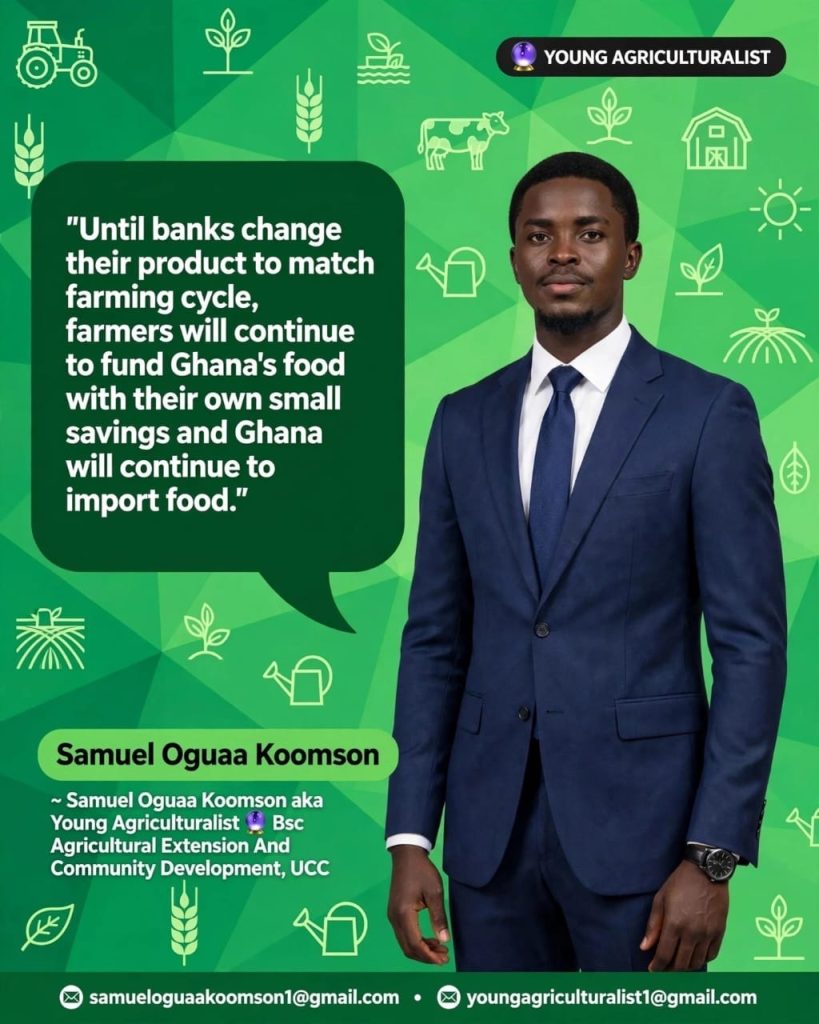
That is the argument advanced by Samuel Oguaa Koomson, also known as Young Agriculturalist, in an analysis submitted to GhanaMedia.
Koomson argues that the problem is not simply that farmers need more loans. Rather, he says financial products must be designed around the realities of agriculture — including weather risks, production cycles, harvest periods, market volatility and the absence of conventional collateral among many smallholder farmers.

Agriculture Contributes Significantly, But Credit Remains Limited
Official Ghanaian government data support part of that argument. The Ministry of Food and Agriculture’s Feed Ghana Programme says agriculture contributes about 22% of Ghana’s GDP, while credit to primary agricultural production represented only 4.7% of total credit in 2024, up from 3.9% in 2023.
The Africa Development Bank has similarly highlighted the financing gap, noting that agriculture in Ghana accounts for a much larger share of economic activity than its share of commercial lending.
Why Agriculture Presents a Different Lending Challenge
Unlike many conventional businesses, agricultural enterprises can have long periods between investment and revenue. A farmer may spend money on land preparation, seeds, fertilizer, labour and other inputs months before receiving revenue from a harvest.
For perennial crops such as mango, cashew and oil palm, the period between investment and meaningful production can be considerably longer.
Koomson argues that conventional repayment structures can therefore place farmers under pressure when monthly repayments begin before their farms generate sufficient cash flow.
Some banks have already developed products that attempt to address this issue. For example, agricultural production loans can be structured around farming seasons, depending on the lender and type of crop.
Weather, Insurance and Market Risks
Agriculture exposes lenders and borrowers to risks that can be less predictable than those associated with many conventional businesses. Drought, excessive rainfall, pests, disease outbreaks and sudden price changes can significantly affect production and farmers’ ability to repay loans.
The Ministry of Food and Agriculture identifies low insurance penetration as one of the weaknesses in agricultural finance, reporting that fewer than 5% of Ghanaian farmers had insurance protection in 2024.
Ghana has also been pursuing mechanisms to reduce these risks. The Ghana Incentive-Based Risk-Sharing System for Agricultural Lending (GIRSAL) provides credit-risk guarantees to participating financial institutions to encourage agricultural lending.
Collateral Remains Another Obstacle
Many smallholder farmers do not possess the type of conventional collateral traditionally preferred by financial institutions. Land ownership and documentation can also be complicated, particularly where farmers operate under customary or informal arrangements.
Koomson argues that financial institutions should therefore make greater use of alternative financing structures, including credit guarantees, warehouse-receipt financing, contract farming, crop insurance and value-chain financing.
Financing the Entire Value Chain
Another major point in Koomson’s analysis is that financing a farmer without financing the infrastructure around the farmer can limit the impact of credit.
A producer may receive money for inputs but still struggle to transport, store, process or market the resulting harvest.
That is why value-chain financing has increasingly become part of agricultural-finance discussions.
Ghana’s Food-Import Challenge
The financing debate is also connected to Ghana’s continuing reliance on imported food.
Ghana Statistical Service data reported by Citi Newsroom show that Ghana spent more than GH¢36.5 billion on food imports in 2025, with processed cereal grains, frozen chicken and rice among the major import categories.
The World Bank’s 2026 AgriConnect Compact likewise identifies improving productivity, market access, finance and value addition as priorities for Ghana’s agricultural sector, with reducing food imports among its objectives.
What Could Improve Agricultural Lending?
- Agricultural credit guarantees
- Crop and weather insurance
- Longer repayment periods linked to harvest cycles
- Warehouse-receipt financing
- Contract farming tied to confirmed buyers
- Agricultural lending officers with sector-specific knowledge
- Digital financing for smallholder farmers
- Financing that covers multiple points in the agricultural value chain
Some of these mechanisms already exist in Ghana in various forms. GIRSAL, for example, provides guarantees to participating financial institutions to help reduce agricultural lending risks.
A Financing System Built Around Agriculture
Koomson’s central argument is that farming cannot always be financed using exactly the same structures used for salaried workers, traders or conventional businesses.
Agriculture has seasonal revenues, weather exposure, production cycles and supply-chain dependencies.
For Ghana to expand domestic food production, the financing system will need to account for those characteristics while also protecting financial institutions against avoidable risks.
As Koomson puts it: “Ghanaian banks want quick, safe, monthly repayment with land title. Ghanaian farming needs long, risky, seasonal repayment with harvest as collateral.”
The debate over agricultural finance therefore extends beyond farmers and banks. It touches food security, imports, employment, rural development and Ghana’s ability to build a stronger domestic food system.
By GhanaMedia.net | Agriculture & Economy Desk
Follow @GhanaMedia123 on X for the latest Ghana and African news updates.